
Lumbar Spinal Fusion Surgery in New Jersey
Medically reviewed by Kevin Yao, MD
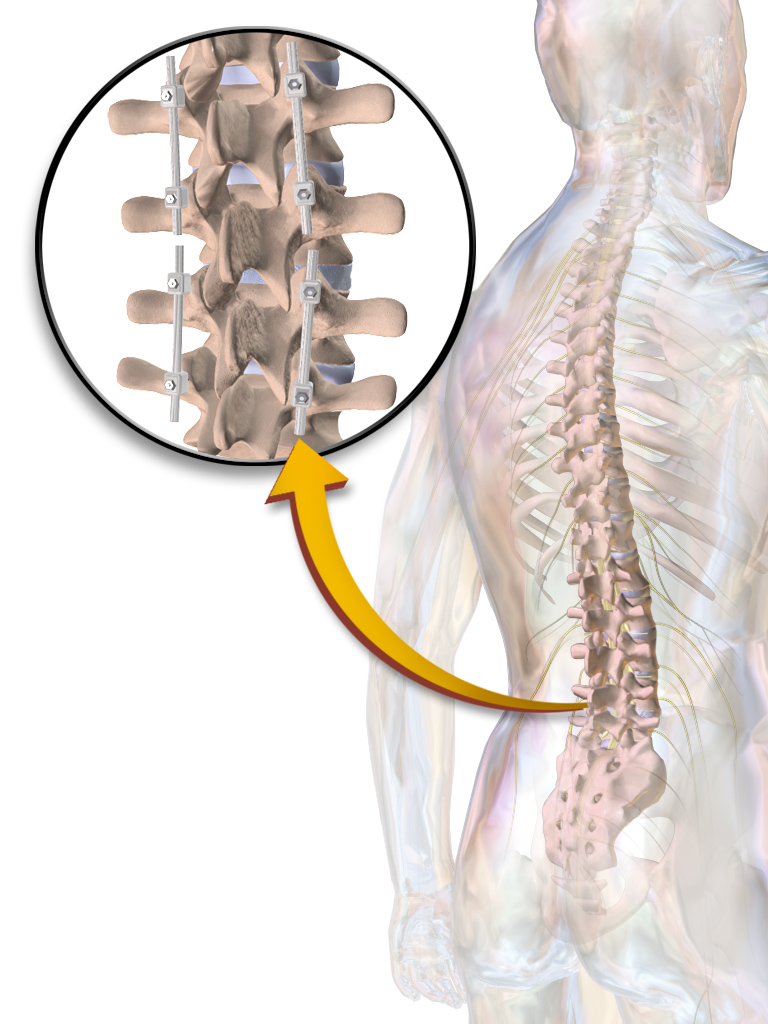
Your MRI shows a problem in your lower back. Perhaps someone has already mentioned fusion. Now you’re trying to work out what that means for your pain, your mobility, and the life you want to get back to.
Lumbar spinal fusion joins two or more vertebrae so they can heal into a stable segment. It can be appropriate when instability, deformity, or certain structural problems make stabilization necessary. But an abnormal scan isn’t, by itself, a reason to fuse the spine. The real question is which part of your back is causing the symptoms—and what treatment is most likely to help.
The question to settle before discussing surgery
Imagine an MRI report listing a slipped vertebra, a worn disc, and a narrowed space around a nerve. Those findings can appear together. They don’t necessarily contribute equally to your symptoms.
That’s why a surgical evaluation begins with the history and neurological examination. Where does the pain travel? Is one leg weaker? What happens when you walk, bend, or sit? How have your symptoms changed, and what treatments have you already tried? Your imaging matters, of course. It matters most when it agrees with what is happening in your body.
Fusion becomes a serious consideration in selected cases of spondylolisthesis, spinal instability, deformity, or a situation where relieving nerve pressure could leave the spine insufficiently stable. Some patients with longstanding back pain won’t benefit from fusion. Others may need decompression without stabilization. Sorting out that difference is part of the work.
What the operation actually does
During a lumbar fusion, the surgeon prepares adjacent vertebrae to grow together over time. Depending on the operation, that may involve bone graft material, implants to hold the area stable, and removal of tissue pressing on nearby nerves. The approach, number of levels, and need for hardware vary with the diagnosis and anatomy.
The intended benefit is stability at the treated level. The tradeoff is reduced motion there. And although an operation may also relieve nerve compression, fusion doesn’t promise to eliminate every source of back pain. It helps to ask one plain question: Which symptom is this particular step meant to improve?
Why decompression or nonsurgical care may be enough
For some patients, the main problem is a compressed nerve. If the spine is otherwise stable, a decompression may relieve that pressure without joining vertebrae. Others may benefit from physical therapy, changes in activity, medication, or a carefully selected injection.
There’s no virtue in rushing toward an operation that isn’t needed. There is also a cost to overlooking progressive neurological problems. Increasing weakness, or new bladder or bowel dysfunction accompanied by neurological symptoms, needs urgent medical assessment. Your clinician can explain whether continued conservative care is reasonable for your particular condition.
Recovery is two different processes
Patients sometimes hear that they may be walking soon after surgery and assume the spine will also be healed. Those are different milestones. Early movement and gradual recovery of daily function may start relatively soon; the bone fusion itself generally takes months. Return to work, driving, lifting, and exercise depends on the operation and the individual.
The risks deserve the same clear conversation as the potential benefits. They may include infection, bleeding, blood clots, nerve injury, persistent pain, failure to fuse, or the need for another operation. Prior surgery, bone health, medical conditions, and the extent of the proposed fusion all affect that discussion. No responsible surgeon can promise a particular result before understanding those details.
Bring the images. Bring the questions.
If you’re considering lumbar fusion or seeking a second opinion, bring the actual MRI images along with the radiology report. Prior X-rays, surgical records, medication lists, and a short account of how your symptoms have changed can be useful too. Standing or flexion-extension X-rays may be discussed when instability is suspected; they aren’t required for every patient.
Kevin Yao, MD, is a board-certified neurosurgeon in Englewood, New Jersey. A consultation can help determine whether fusion, a smaller procedure, or continued nonsurgical treatment best matches the evidence. You should leave understanding the reasoning, even if the recommendation is to wait.
Questions patients ask
Does a herniated disc mean I need a fusion?
How is lumbar fusion different from a laminectomy?
Will fusion eliminate my back pain?
What should I ask during a second opinion?
Next step: clarify the recommendation
If lumbar fusion has been recommended, you can request a neurosurgical consultation with Dr. Yao in Englewood. The point of that visit is to understand the options and their tradeoffs before deciding what comes next.
Contact Dr. Yao’s Office · Call (201) 614-1221
Medical information here is educational and is not a substitute for individualized care. Sudden or severe neurological symptoms require urgent medical assessment.
Clinical sources
MedlinePlus: spine surgery recovery
Englewood Health: spine surgery