
Lumbar Laminectomy and Spinal Decompression Surgery
Medically reviewed by Kevin Yao, MD
Some people with lumbar spinal stenosis can walk only a short distance before their legs begin to ache, burn, or feel heavy. They stop, lean on a cart, or sit down. The discomfort eases. They try walking again, and the cycle repeats. What looks like a problem with stamina may actually be a problem with space around the spinal nerves.
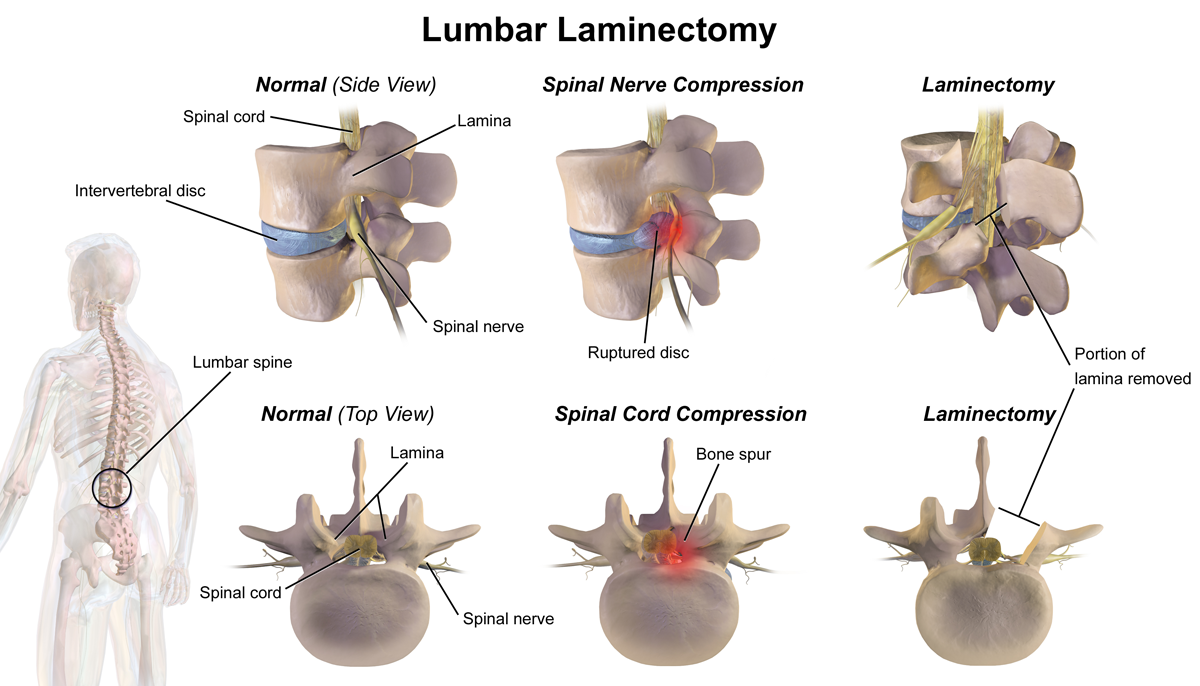
Lumbar laminectomy is a type of decompression surgery. It removes part of the bony covering of the spinal canal, and sometimes other arthritic tissue, to give compressed nerves more room. The operation may be considered when spinal stenosis causes substantial symptoms or limits function despite appropriate nonsurgical care.
Why walking can become difficult
The spinal canal is the passage through which nerves travel. With age or other structural changes, discs, joints, bones, and ligaments can narrow that space. When a person stands or walks, the resulting pressure may produce pain, tingling, heaviness, or weakness in the legs. Sitting or leaning forward often helps.
That pattern is a clue, not a final diagnosis. Hip disease, vascular problems, neuropathy, and other conditions can affect walking too. A clinician compares your symptom history, physical findings, and imaging to decide whether stenosis is the most likely cause.
What happens in a lumbar laminectomy?
The lamina forms part of the bony arch behind the spinal canal. During a laminectomy, the surgeon removes some of that bone to create space. Thickened ligament or other tissue pressing on nerves may also be removed. Some patients need a smaller, more targeted decompression rather than a broad laminectomy.
The purpose is to relieve nerve pressure. That is distinct from spinal fusion, whose purpose is to stabilize vertebrae. Understanding the distinction helps make sense of why two patients with stenosis might receive different surgical recommendations.
When surgery enters the conversation
The degree of narrowing shown on an MRI is only one of many factors that goes into the decision about treatment. Someone with significant stenosis on imaging but few symptoms may have a different plan from someone whose ability to walk or work has become severely limited.
Physical therapy, activity adjustments, medications, and selected injections may help manage symptoms. Surgery becomes a possible treatment when limitations remain substantial, pain is difficult to control, or neurological problems progress. The surgeon should explain what improvement is realistic and which complaints may have a different cause.
Does decompression also require fusion?
Not necessarily. In a stable and appropriately aligned lumbar spine, decompression alone may be appropriate. Fusion can enter the discussion if there is instability, vertebral slippage, deformity, or concern that the decompression itself would compromise stability.
Ask to see the evidence if fusion is recommendedn. Is the spine unstable now? Which levels are affected? Would removing a smaller amount of tissue preserve stability and make fusion unnecessary? These are appropriate questions whose answers will give you more insight into the proper choice of surgery.
Results, risks, and the pace of recovery
Improving leg symptoms and walking tolerance can be important goals of decompression. But nerves that have been compressed for a long time may not recover fully, and other causes of pain or mobility problems can remain. The likely benefit from surgery is individual.
Potential complications include infection, bleeding, nerve damage, spinal fluid leak, persistent or recurrent symptoms, and the need for another operation. Walking may begin early after surgery, while restrictions on lifting or strenuous activity depend on the extent of the procedure and your surgeon’s instructions.
New bladder or bowel dysfunction, rapidly worsening weakness, or numbness in the saddle area calls for urgent or emergency assessment. These symptoms should not wait for a routine outpatient appointment.
What should I bring to my appointment?
Before the appointment, note how far you can walk before symptoms appear, whether leaning forward or sitting helps, and whether you’ve experienced falls or loss of strength. Bring your lumbar MRI and prior treatment history. If you’ve already been offered decompression with fusion, bring the specifics about that recommendation as well.
Dr. Kevin Yao provides neurosurgical evaluation for spine conditions in Englewood, New Jersey. A good consultation explains why the narrowing appears to be responsible for your symptoms and which treatment would best address it.
Questions patients ask
Is laminectomy the same as fusion?
Can lumbar stenosis improve without surgery?
Will I be able to walk farther afterward?
When is stenosis an emergency?
Next step: get the walking problem explained
If standing or walking has become difficult and you have imaging showing lumbar stenosis, request a consultation with Dr. Yao. Bring the scan and the details of what you can—and cannot—comfortably do.
Contact Dr. Yao’s Office · Call (201) 614-1221
Medical information here is educational and is not a substitute for individualized care. Sudden or severe neurological symptoms require urgent medical assessment.
Clinical sources
NHS: lumbar decompression surgery
Englewood Health: spine surgery